
Why timing matters more in Zanzibar than you might think
Zanzibar is one of those places that sounds simple (white sand, warm water, a spice-scented old town) and mostly is. It sits just six degrees south of the equator, so it is warm every single day of the year. What changes, and what makes the difference between a good trip and a genuinely great one, is the rain, the wind, the tides and the crowds.
For South Africans it has also never been easier to get to. There are direct flights from Johannesburg in around three and a half hours, a brand-new non-stop service from Cape Town, and no visa to arrange. So the question isn't really whether to go, it's when, and which part of the island to base yourself on. This guide answers both, month by month and traveller by traveller.
When is the best time to visit Zanzibar?
The best time to visit Zanzibar is during the long dry season, from late June to October, when days are sunny and comfortable (around 28–30°C), humidity is at its lowest and rain is rare. The second-best window is the short, hot dry spell of January and February: hotter and more humid, but with calm, clear seas that suit swimming, snorkelling and diving.
The months to be more careful with are April and May, the heart of the long rains, when downpours are heavy and a number of smaller beach lodges close. The short rains of November and early December are lighter and less predictable, often a passing afternoon shower rather than a lost day.
If you want our honest pick: September for the best all-round balance of weather, sea and value, and late January to February if warm, glassy water matters more to you than a cooling breeze.
Zanzibar seasons at a glance
Zanzibar doesn't have summer and winter in the way we do; it has wet seasons and dry seasons, shaped by two monsoon winds the Swahili coast has sailed by for centuries: the kaskazi from the north-east (roughly December to March) and the stronger kusi from the south-east (roughly June to October).
- Long dry season (late June to October): sunny, drier and the most comfortable temperatures of the year, with cooler evenings around 20–22°C. The kusi trade wind keeps things fresh, but it also stirs up the east coast. Peak season for good reason.
- Short rains (November to mid-December): warm and increasingly humid, with showers that come and go. Greener, quieter and often better value before the festive rush.
- Short dry season (mid-December to February): hot (32–33°C by February), humid and mostly dry, with the calmest, clearest seas of the year. The festive weeks are the island's busiest and priciest.
- Long rains (March to May): the wettest time of year; April is the peak, with heavy, frequent downpours. Low season, lowest prices, and some lodges close altogether.
Zanzibar weather month by month
A quick-reference view to match your dates to the island. Temperatures are typical daytime highs; sea temperatures run from around 25°C in July and August to 29°C in February and March.
| Month | Weather | Sea and beach | Crowds and prices | Our verdict |
|---|---|---|---|---|
| January | Hot, humid, drying out | Calm, clear, warm | High early in the month, easing | Excellent: beach and diving |
| February | Hottest month, mostly dry | Calmest, clearest water | Moderate | Excellent: honeymoons and diving |
| March | Hot and humid; rains begin | Still warm and clear | Quieter | Good value, some risk of rain |
| April | Wettest month | Rougher, murkier | Very quiet; some lodges close | Best avoided for a beach trip |
| May | Wet, easing late in the month | Variable | Very quiet | Low season, lowest prices |
| June | Rains end; drying and clearing | Kusi wind picks up | Rising from mid-month | Good, especially later in June |
| July | Dry, sunny, pleasant | Breezy east coast; calm north | High: peak season | Excellent: families and safari combos |
| August | Dry, coolest month (20–29°C) | Breezy east coast; calm north | High: peak season | Excellent: safari combos |
| September | Dry, sunny, comfortable | Clear, breeze easing | Busy, not frantic | Our top all-round pick |
| October | Dry, warming up | Settling, visibility improving | Moderate | Excellent: value and diving |
| November | Short rains; showers | Warm, variable | Quiet | Good value, flexible weather |
| December | Showers early; drying and hot late | Warm, calming | Quiet early, peak over festive | Great late in the month: book early |
The single most useful thing to know: Zanzibar is warm in every month, but the dry seasons give you the most reliable sunshine and the clearest water, and where you stay on the island matters almost as much as when you go.
North coast or east coast? Why where you stay changes the answer
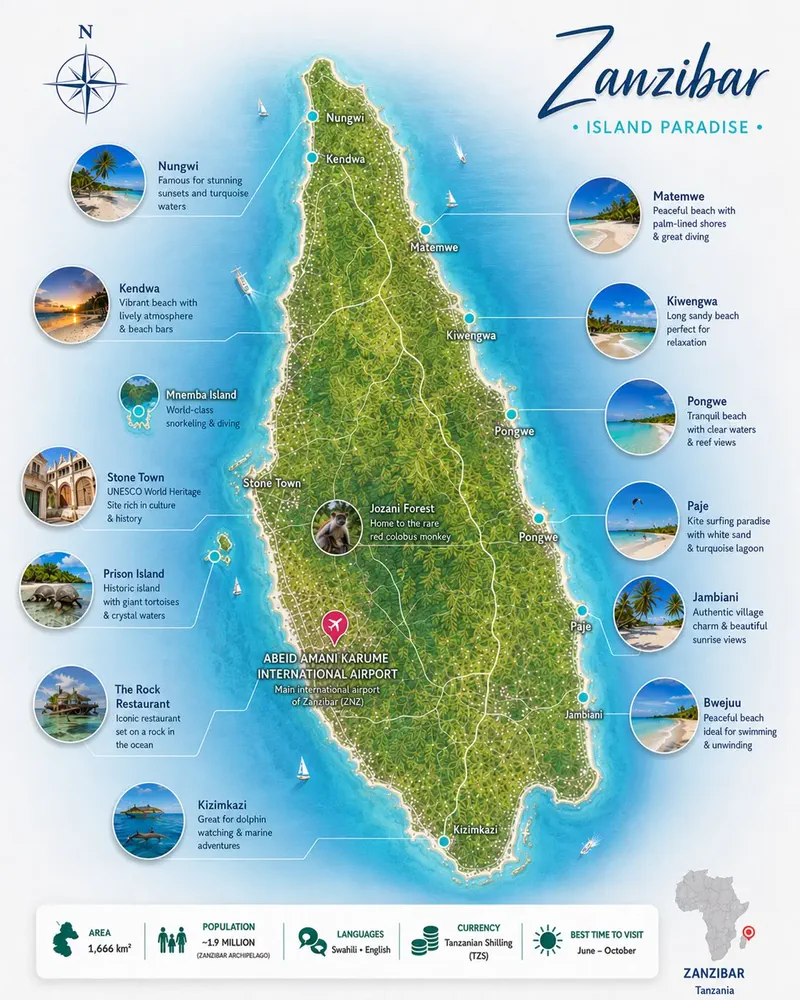
Zanzibar's beaches behave very differently depending on which way they face, and it's the thing first-time visitors most often get wrong. Two forces decide it: the tide and the wind. The map below shows where each beach sits, or explore every coast region by region on our interactive Zanzibar map.
The north coast: Nungwi and Kendwa
The northern tip of the island is the easy choice for swimming. Kendwa in particular barely feels the tide, so you can swim at any time of day, and its west-facing beach delivers some of the best sunsets in the Indian Ocean. Nungwi, just around the headland, is livelier, with more restaurants, dhow builders on the sand and a busier evening scene.
Crucially, the north is sheltered from the kusi wind, so from June to October, when the east coast can be breezy, Nungwi and Kendwa stay calm, clear and swimmable. If you're travelling in the long dry season and want a classic swim-off-the-beach holiday, this is where we'd usually point you.
The east coast: Matemwe, Paje and Jambiani
The east coast is Zanzibar at its most beautiful and most dramatic: wide, powder-white beaches, a lagoon held behind the outer reef, and a far greater tidal range. At low tide the sea can pull back a kilometre or more, exposing sandbanks, rock pools and the seaweed farms tended by local women. At high tide the lagoon fills again and turns an almost impossible shade of turquoise.
- Matemwe is quiet, village-paced and the closest beach to Mnemba Atoll, the island's best-known snorkelling and diving site. A favourite for couples who want peace.
- Paje is Zanzibar's kitesurfing hub: sociable, relaxed and at its best when the wind blows (the kusi from June to October and the kaskazi from mid-December to February).
- Jambiani is a long, laid-back village beach, with a more local feel and some lovely small boutique properties.
The east coast rewards travellers who don't mind planning around the tide: swim at high water, walk the sandbanks at low water. It is at its calmest between the two trade winds (roughly October to early December and March). If uninterrupted swimming is the priority, ask us which properties have a pool or sit near a deeper channel.
The best time to visit Zanzibar for your kind of trip
There's no single best month; there's a best month for you. Here's how we match the calendar to the traveller.
Best overall weather: late June to October
This is Zanzibar's long dry season and the most comfortable time of year: sunshine most days, low humidity, warm afternoons and pleasantly cool evenings. September is the sweet spot: the wind starts to ease, the water is clear and peak-season demand is beginning to soften.
Best for a beach holiday: July to October, and January to February
For pure beach days, both dry seasons work: they simply suit different coasts. From July to October, base yourself on the sheltered north coast. In January and February, the east coast is at its most glassy and inviting, with the calmest, warmest water of the year.
Best for diving and snorkelling: October to March
Underwater visibility is generally at its best from October through to March, when the seas are calmer between the stronger kusi winds. Mnemba Atoll, a protected marine conservation area off the north-east coast, is the headline site, with turtles, reef fish and dolphins, and whale sharks are sometimes seen in the surrounding waters from around October to February (never guaranteed, always a thrill). February, the calmest month of all, is hard to beat.
Best for families: the South African June–July school holidays
This is where the calendar is kind to South Africans. Our winter school holidays fall squarely in Zanzibar's long dry season (in 2027 they run from 26 June to 19 July), which means sunshine, lower humidity and comfortable temperatures for children. The short spring break in early October (2 to 10 October in 2027) is another excellent window, often with better value.
For families, we generally recommend the north coast or a resort with a good pool, so swimming doesn't depend on the tide. Add a half-day at Jozani Forest to see the rare red colobus monkeys, and a trip to the giant tortoises on Prison Island, and the whole family will come home with stories.
The December holidays are also popular, but they're peak season: the best family rooms go early, and prices climb sharply from around 20 December into early January.
Best for honeymooners: September to October, and January to February
For couples, we love two windows. September and October offer dry, golden days, gentle evenings and a little more space at the best boutique hotels. Late January to February is hotter, but the sea is at its most beautiful and the light is soft and romantic. Pair a few nights in a Stone Town heritage hotel with a quiet east-coast or Matemwe hideaway, and add a sunset dhow cruise: it never gets old.
Best for combining Zanzibar with a Tanzania safari: June to October, or January to February
Zanzibar pairs beautifully with mainland Tanzania: fly from the Serengeti or Arusha to the island in a couple of hours and swap the dust for the sea. The timing lines up in two ways:
- June to October: Tanzania's dry season gives the easiest game viewing, and from roughly July to October the Great Migration's herds are in the northern Serengeti for the dramatic Mara River crossings. Zanzibar is in its long dry season at the same time. This is the classic safari-and-beach combination.
- January to February: the wildebeest calving season on the southern Serengeti plains around Ndutu, when hundreds of thousands of calves are born in a few short weeks, coincides with Zanzibar's hot, calm short dry season. A superb and slightly less crowded alternative.
We almost always plan it safari first, beach second: you finish the trip rested rather than exhausted. Take a look at our safari planning, or read how the same idea works in our Kenya beaches and safari guide.
Best for quieter travel: early June, March and November
If you'd rather have the beach to yourself, aim for the edges of the seasons. Early June (as the long rains clear), March (before they arrive in earnest) and November (the short rains) are all noticeably quieter. You trade a little weather certainty for emptier sand, easier restaurant bookings and better service attention.
Best for value: shoulder months, outside the festive peak
The best value sits in the shoulder weeks: early June, late October to mid-December (before the festive rates kick in) and March. Accommodation in Zanzibar is usually priced in US dollars, so for South Africans the rand exchange rate matters as much as the season: locking in your booking early protects you against rand weakness later. We keep an eye on current Zanzibar holiday offers, and our Deal Seeker gathers every current deal and online quote in one place.
When to avoid, and why it still might be fine
April and May bring Zanzibar's heaviest rain, high humidity and rougher seas, and a number of smaller lodges close for the season. For a first visit or a once-in-a-lifetime honeymoon, we'd steer you elsewhere in the calendar.
That said, the rain often falls in heavy afternoon bursts rather than all day, the island is lush and green, and the resorts that stay open offer their lowest rates of the year. For flexible, return visitors who mostly want a quiet, good-value break, it can work, just go in with the right expectations, and make sure your travel insurance is in place.
It's also worth knowing about Ramadan. Zanzibar is predominantly Muslim, and during the holy month (expected to run from around 7 February to 8 March 2027, depending on the moon), many Stone Town restaurants close during daylight hours and modest dress becomes even more important in town. Resorts operate as normal, and the evenings in Stone Town, when families gather to break the fast, can be genuinely special. It isn't a reason to avoid Zanzibar; it's a reason to plan with respect.
Beyond the beach: when to explore Stone Town and the spice farms
Stone Town, a UNESCO World Heritage Site, is best explored in the drier, cooler months (June to October), when wandering its alleyways, carved doors, markets and the Forodhani night-food gardens is a pleasure rather than a sweat. A morning spice tour (cloves, nutmeg, cinnamon, vanilla and lemongrass, straight from the plant) works in any month and is a favourite with families.
We usually suggest two nights in Stone Town at the start or end of the trip, and the rest on the beach.
Planning your Zanzibar holiday from South Africa
Zanzibar is one of the most accessible island escapes from South Africa. A few practical notes so nothing catches you out:
- Entry and visas. South African passport holders do not need a visa for Tanzania, including Zanzibar, for stays of up to 90 days. Your passport should be valid for at least six months with blank pages. Rules can change, so check before you travel: our visa and entry information page points you to the official sources.
- Zanzibar's mandatory inbound insurance. Since October 2024, every foreign visitor to Zanzibar must buy the government's inbound travel insurance from the Zanzibar Insurance Corporation before arrival. The standard price is US$44, but travellers from SADC countries, including South Africa, currently pay US$22. You'll receive a QR code to show at immigration. It is compulsory even if you already have your own cover.
- Your own travel insurance. The Zanzibar policy is basic, so comprehensive cover, including medical evacuation, is still essential, especially if you're adding a safari. Arrange travel insurance before you go. (Mainland Tanzania introduces its own inbound insurance from 1 October 2026; SADC residents are currently exempt, but confirm this against your itinerary.)
- Getting there. Direct flights from Johannesburg take around three and a half hours, with several airlines on the route, including Airlink and FlySafair. From 3 October 2026, Airlink operates the first non-stop flight from Cape Town: weekly, on Saturdays. Other routings connect through Dar es Salaam, Nairobi or Addis Ababa.
- Health. A yellow fever certificate is not required when flying directly between South Africa and Tanzania, but Kenya is on South Africa's yellow fever list, so if you connect through Nairobi, check whether you'll need one on your return. Zanzibar is a low-malaria area but not malaria-free; speak to a travel clinic about precautions.
- Money. The Tanzanian shilling is the local currency, but US dollars are widely used for hotels, activities and tips: bring clean, recent notes.
- Respect the culture. Beachwear belongs on the beach. In Stone Town and the villages, covering shoulders and knees is appreciated, and always ask before photographing people.
For the most current official information, the Zanzibar Commission for Tourism and the official Zanzibar inbound insurance portal are the sources we point travellers to.
Frequently asked questions
What is the best month to visit Zanzibar?
September is our favourite all-rounder: dry, sunny and comfortable, with clear water and slightly softer demand than July and August. If you prefer hot, calm and glassy seas, February is outstanding.
What is the rainy season in Zanzibar?
The long rains run from roughly March to May, peaking in April, when downpours are heavy and some lodges close. The short rains fall in November and early December and are lighter and less predictable, often as brief afternoon showers.
Is Zanzibar good to visit in July and August?
Yes, it's peak season for good reason. The weather is dry, sunny and at its most comfortable, and it lines up perfectly with the South African winter school holidays and the Serengeti migration. Base yourself on the north coast, which is sheltered from the south-easterly kusi wind at this time of year.
Do South Africans need a visa for Zanzibar?
No. South African passport holders can visit Tanzania, including Zanzibar, visa-free for up to 90 days. You do need to buy Zanzibar's mandatory inbound travel insurance before arrival, which currently costs US$22 for travellers from SADC countries.
Which is better, Nungwi or Paje?
It depends on what you want. Nungwi, on the north coast, has minimal tides, easy all-day swimming and beautiful sunsets. Paje, on the east coast, has a huge tidal lagoon, a relaxed, sociable village feel and is Zanzibar's kitesurfing centre. Swimmers and families usually prefer the north; couples and kitesurfers often love the east.
How many days do you need in Zanzibar?
Seven nights is ideal for a first visit: two in Stone Town and five on the beach. Ten nights lets you split the beach stay between two coasts, and if you're adding a Tanzania safari, allow three to four nights on safari first.
When can you see whale sharks in Zanzibar?
Whale sharks are sometimes seen around Mnemba Atoll from roughly October to February, with the best chances in the middle of that window. Sightings are never guaranteed, so treat one as a bonus rather than the reason for your dates.
Final recommendations
If you want the simplest answer: go in September or October for the best balance of weather, sea and value, July and August if you're travelling in the school holidays or combining a safari, and February if calm, clear water is everything. Choose the north coast for easy swimming and sunsets, and the east coast for wide lagoons, quiet villages and the kind of view that stops you mid-sentence.
Zanzibar rewards a trip that's thoughtfully put together: the right coast for the month, a hotel that suits the tides, flights that make the most of your leave, and a safari that flows into the beach without wasted days. That's the kind of planning we love. Tell us your dates and what you have in mind, and we'll shape a tailor-made Zanzibar holiday around them. No obligation, and a personal reply from our team. If you're still weighing up your island options, our guide to the best time to visit Mauritius and our Zanzibar destination page are a good next read.
Planning a Zanzibar trip?
Traville Travel arranges Zanzibar holidays personally, from flights to the finer details. Tell us what you have in mind and we will build a tailor-made quote, no obligation.


